Introduction
In today’s highly competitive digital landscape, businesses can no longer rely solely on a traditional website to generate leads, increase sales, or grow online visibility. Consumers move quickly, attention spans are shorter than ever, and brands have only a few seconds to convince visitors to stay, trust, and take action. This is where the concept of an AFG landing page becomes critically important.
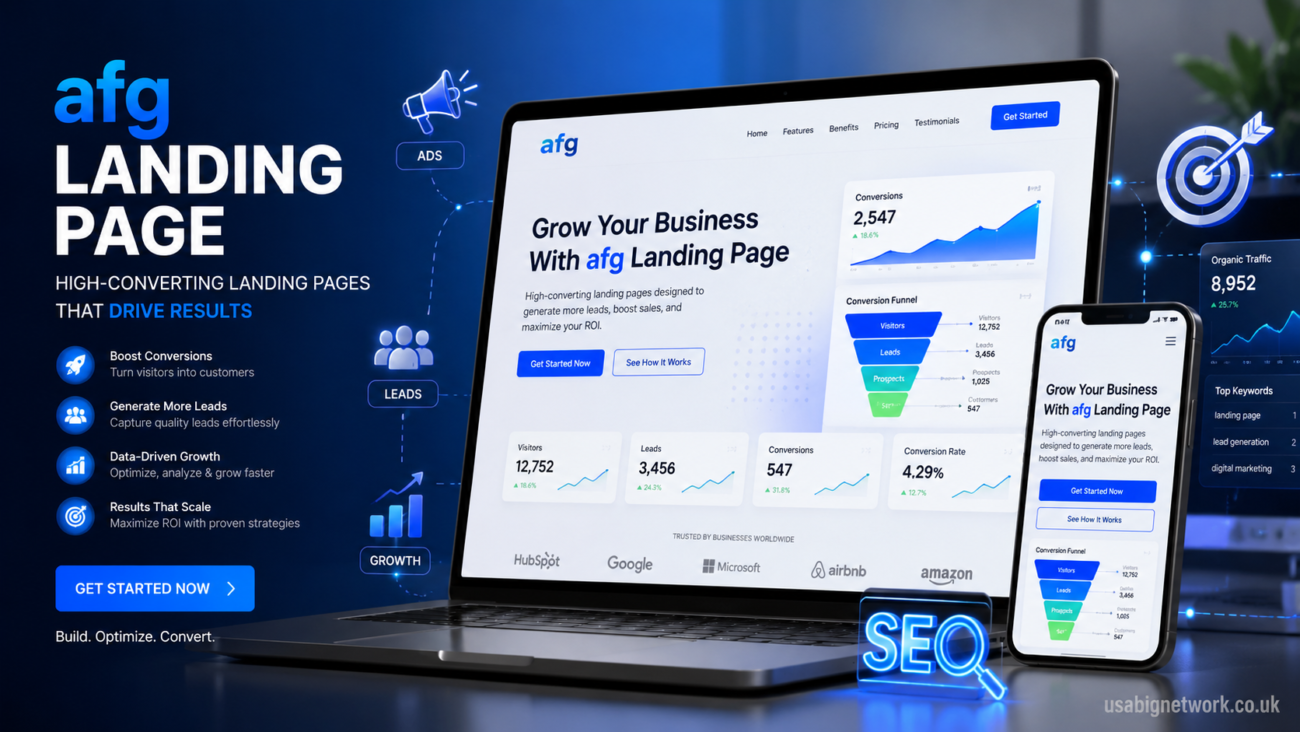
An AFG landing page can be understood as an Audience-Focused Growth landing page—a strategic, conversion-driven web page designed specifically to turn visitors into leads, customers, or subscribers through highly targeted messaging and optimized user experience. Unlike a homepage, which serves multiple purposes and audiences, an AFG landing page focuses on one audience, one problem, one offer, and one goal.
The importance of landing pages has grown significantly in recent years because businesses now spend more on paid traffic through platforms like Google Ads, Meta Ads, LinkedIn Ads, YouTube, and email marketing. When paid traffic becomes more expensive, conversion efficiency matters more. A well-designed landing page helps ensure every click has the best chance of producing a measurable result. Industry guides consistently describe landing pages as standalone pages designed for one conversion goal, helping reduce distractions and improve ROI.
This complete guide explores what an AFG landing page is, why it matters, how it works, and how businesses can use it to maximize growth in 2026 and beyond.
Understanding the Meaning of an AFG Landing Page
At its core, an AFG landing page is built around a simple principle: put the audience first. Traditional web pages often prioritize brand messaging, company history, or broad information architecture. An AFG landing page reverses that thinking by focusing entirely on what the visitor wants, needs, and expects.
When someone clicks an ad or a marketing link, they arrive with intent. They may want a free consultation, a product demo, a discount code, or access to a downloadable resource. If the landing page immediately addresses that exact need, trust increases. If it fails to match that intent, users leave.
This is why AFG landing pages are often called intent-matching pages. Their messaging aligns with the visitor’s search term, ad copy, or referral source. Every word, image, and design element supports a single action. That action may be signing up, booking, buying, downloading, or subscribing.
Unlike ordinary webpages that invite exploration, an AFG landing page is intentionally narrow. Its purpose is not to inform broadly; its purpose is to convert effectively.
Why AFG Landing Pages Matter in Modern Marketing
Marketing costs continue rising across nearly every digital platform. Paid search competition has increased, social advertising is more expensive, and organic reach has declined on many channels. Businesses therefore need stronger conversion systems.
Sending traffic directly to a homepage is one of the most common and costly mistakes marketers make. Homepages are built for browsing. They include menus, multiple links, and competing objectives. Visitors often become distracted and leave before taking action.
AFG landing pages solve this by removing unnecessary choices. They focus attention on one specific offer. This reduces decision fatigue and makes it easier for visitors to complete the intended action.
For example, if an advertisement promises “Book a Free SEO Audit,” the landing page should focus entirely on that offer. The headline should reinforce it. The supporting text should explain the benefits. The form should capture relevant information. Everything should support that one goal.
This alignment between ad and landing page—often called message match—is one of the strongest drivers of conversion success.
The Core Structure of a High-Converting AFG Landing Page
A successful AFG landing page begins with a powerful headline. The headline is usually the first thing visitors read, and often the deciding factor in whether they stay or leave. It must clearly communicate value immediately.
The next layer is the supporting subheadline. This expands on the promise made in the headline and adds clarity. If the headline grabs attention, the subheadline builds confidence.
The hero section often includes an image, video, or visual demonstration of the offer. Humans process visuals faster than text, so this section helps reinforce trust and understanding quickly.
The body copy must focus on benefits, not just features. Visitors care less about technical details and more about outcomes. They want to know how the offer improves their lives, saves time, reduces costs, or solves pain points.
Finally, the call-to-action must be impossible to miss. Strong CTA buttons such as “Start My Free Trial” or “Get My Free Quote” typically outperform vague buttons like “Submit.”
Audience Research and Intent Mapping
The most effective AFG landing pages begin long before design starts. They begin with audience research.
Understanding your target visitor is essential. What problem are they trying to solve? What fears or objections might stop them from converting? What motivates them emotionally? What language do they use?
Audience intent can often be grouped into categories. Some visitors are informational—they want education. Others are transactional—they want to buy now. Others are comparative—they are evaluating options.
A landing page designed for a ready-to-buy visitor should look very different from one designed for someone early in the buyer journey. This is why many advanced marketers create multiple landing pages for different traffic sources and audience segments.
When landing pages reflect real customer intent, conversion rates rise significantly.
The Role of Design and User Experience
Design is not decoration. In landing page optimization, design is persuasion.
Every visual decision should guide the visitor toward action. Clean layouts improve readability. Strategic whitespace reduces overwhelm. Strong contrast helps call-to-action buttons stand out.
Typography also matters. Headlines should be bold and scannable. Paragraphs should be readable and easy to digest. Long walls of text create friction and reduce engagement.
Mobile responsiveness is especially critical. A majority of users now visit landing pages on smartphones. If the page loads slowly, looks broken, or requires zooming, conversions decline rapidly.
Page speed also affects both user experience and search visibility. Research consistently shows that even small loading delays can reduce conversion rates dramatically.
AFG landing pages are therefore built with mobile-first, speed-first design principles.
Writing Persuasive Copy That Converts
Copywriting is one of the most powerful components of an AFG landing page because words influence trust, emotion, and action.
Strong landing page copy starts by identifying a problem. It then presents a clear solution. It explains the transformation the visitor can expect and why the offer is credible.
The best copy speaks directly to the reader using “you” language. Instead of talking about the company, it talks about the customer’s needs.
Emotional triggers also matter. Fear of missing out, urgency, social proof, exclusivity, and relief are powerful motivators when used ethically.
Trust language is equally important. Phrases such as “no credit card required,” “cancel anytime,” or “trusted by 10,000 businesses” reduce anxiety and encourage action.
Ultimately, great copy makes the visitor feel understood—and that feeling drives conversions.
SEO Benefits of AFG Landing Pages
Although many people associate landing pages with paid advertising, they can also be powerful SEO assets.
When optimized correctly, landing pages can rank for targeted long-tail keywords such as “best CRM software demo,” “free accounting consultation,” or “local dental implant specialist.”
Search engines reward pages that closely match user intent. Since AFG landing pages are built around intent, they naturally support stronger relevance signals.
SEO optimization includes strategic keyword placement in titles, headings, meta descriptions, and body content. It also includes internal linking, schema markup, fast loading speeds, and mobile usability.
However, keyword stuffing should always be avoided. Modern SEO rewards quality, clarity, and user satisfaction—not unnatural repetition.
A properly optimized landing page can generate both paid and organic traffic, increasing long-term marketing efficiency.
Conversion Rate Optimization and Testing
Launching a landing page is only the beginning. Real growth comes through continuous optimization.
A/B testing allows marketers to compare different versions of a page. They may test headlines, button colors, CTA wording, images, forms, or layout changes.
Even small changes can create major performance improvements. A better headline might improve conversions by 15%. A shorter form might improve them by 30%.
Behavior tracking tools such as heatmaps and session recordings help identify friction points. If users stop scrolling or abandon forms, those insights reveal what needs fixing.
Top-performing companies treat landing pages as living assets, not one-time projects. They continuously refine based on data.
This ongoing testing mindset is what separates average landing pages from elite AFG landing pages.
Common Mistakes That Hurt AFG Landing Page Performance
Many businesses unintentionally damage performance by overcomplicating their landing pages.
One common mistake is including too many links. Navigation menus, social icons, and unrelated offers pull visitors away from the primary goal.
Another mistake is weak messaging. If the headline is vague or confusing, visitors leave quickly.
Poor mobile optimization is another major issue. A page that looks perfect on desktop but fails on mobile loses valuable traffic.
Lack of trust signals also reduces conversions. Testimonials, reviews, case studies, certifications, and guarantees help reassure hesitant visitors.
Finally, many businesses stop after launching a page and never test it again. Without optimization, performance often plateaus.
The Future of AFG Landing Pages
Landing pages are evolving rapidly thanks to artificial intelligence, automation, and personalization technology.
AI tools can now help marketers generate headlines, predict conversion performance, personalize content dynamically, and automate testing workflows.
Dynamic landing pages can change content based on visitor behavior, location, device, or traffic source. This makes pages feel more relevant and increases engagement.
Voice search, conversational interfaces, and zero-click search experiences are also shaping future landing page design. Simplicity, speed, and clarity will become even more important.
As competition increases, businesses that adopt smarter landing page strategies will gain a measurable advantage.
Conclusion
An AFG landing page is far more than a simple webpage. It is a strategic conversion asset designed to align audience intent, persuasive messaging, smart design, and measurable business outcomes.
In a digital world where every click costs money and every second matters, businesses cannot afford inefficient marketing funnels. A well-built AFG landing page helps maximize return on ad spend, improve lead generation, and create better customer experiences.
The most successful landing pages are not created by chance. They are built through research, audience understanding, thoughtful design, compelling copy, and continuous optimization.
Whether you are a startup, an e-commerce brand, a SaaS company, or a local service provider, investing in a strong AFG landing page strategy can transform your digital growth—and in 2026, that competitive advantage matters more than ever.
