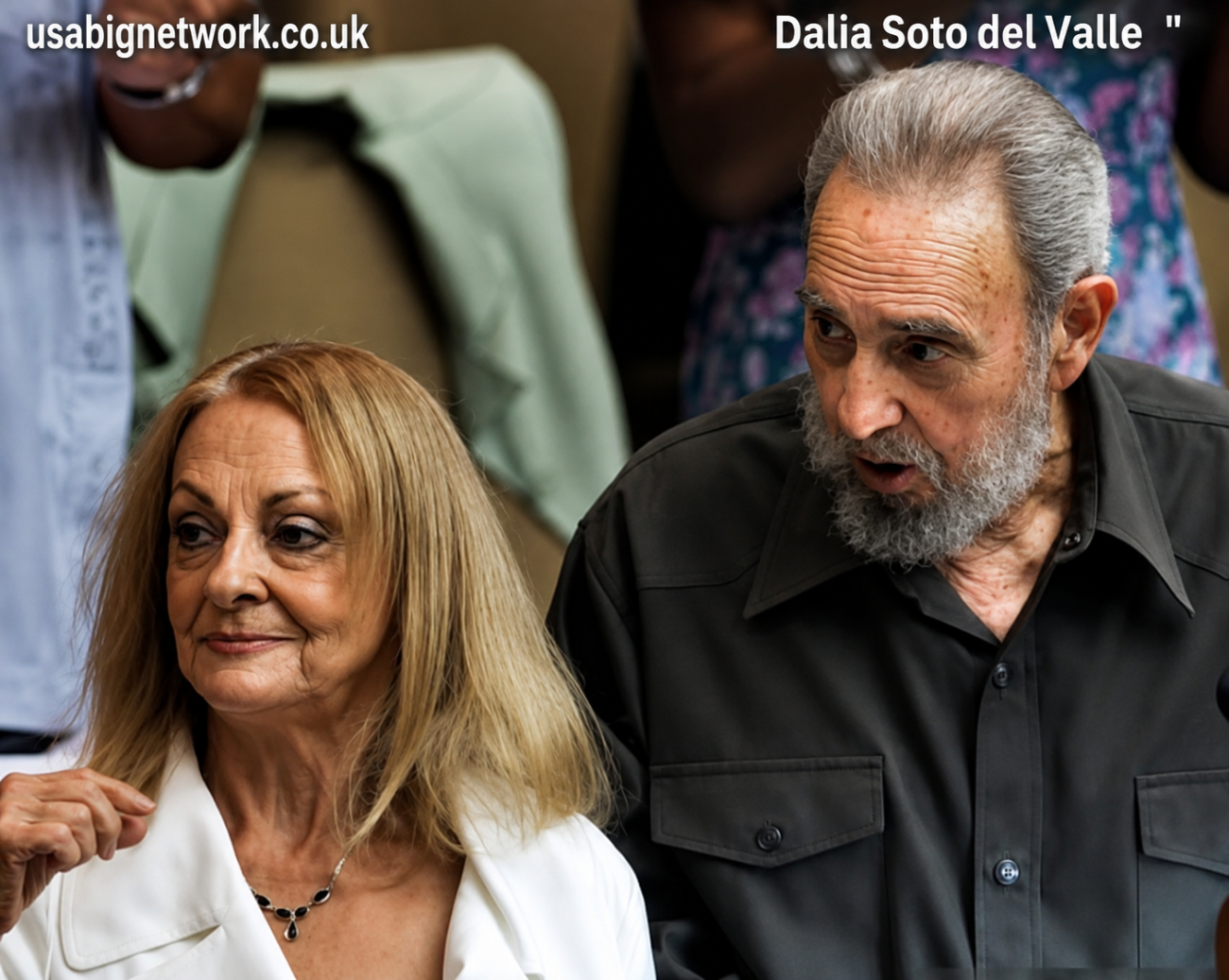
Dalia Soto del Valle is one of the most private figures connected to the life of Fidel Castro. For decades, she lived largely away from public attention while sharing her life with the Cuban revolutionary leader and raising their five sons. Unlike the wives or partners of many political leaders, Dalia did not build a public career around her relationship with Castro. Her name became known internationally mainly through reporting about Castro’s family, his private life, and the extraordinary secrecy that surrounded his household.
Dalia’s story is especially interesting because it reveals a different side of Fidel Castro. Publicly, Castro was one of the most recognizable political figures of the twentieth century. Privately, however, he protected his family from public attention. Dalia remained largely invisible during much of his rule, and even basic information about their children was difficult for journalists and ordinary Cubans to obtain. Her life therefore sits at the intersection of Cuban political history, family history, privacy, and the unusual way Castro separated his public identity from his personal world.
Who Was Dalia Soto del Valle?
Dalia Soto del Valle was a Cuban schoolteacher who became Fidel Castro’s longest-lasting partner. Reports describe her as a woman from the central Cuban area of Trinidad who became involved in the revolutionary government’s literacy campaign during the early 1960s. It was through this environment that she reportedly met Castro. Her background was very different from the image of a politically powerful first lady because she began her adult life as an educator rather than as a major revolutionary leader.
According to accounts published about Castro’s private life, Dalia later moved to Havana at Castro’s initiative and became part of his secluded family household. Her relationship with him continued for decades. The exact details of her early life are difficult to establish because there is relatively little independent biographical information about her compared with other members of the Castro family. This lack of documentation is itself an important part of understanding Dalia Soto del Valle.
How Dalia Met Fidel Castro
Dalia reportedly met Fidel Castro around 1961, during the period when Cuba was carrying out its nationwide literacy campaign. The campaign was an important part of the revolutionary government’s educational program, and teachers were sent into communities to help expand literacy. Dalia’s involvement in education placed her in an environment where she could come into contact with senior figures of the new Cuban government.
Accounts differ slightly about the precise circumstances of their first meeting, but the broader story is consistent: Dalia became connected with Castro during the early revolutionary period and eventually became his permanent companion. Their relationship developed during a time when Castro’s government was becoming increasingly powerful and Cuba was entering a highly tense period of Cold War politics. While Castro’s political activities attracted worldwide attention, his relationship with Dalia remained mostly hidden from ordinary public view.
Dalia Soto del Valle and Fidel Castro’s Relationship
Dalia and Fidel Castro remained together for more than four decades, making their relationship the longest-lasting partnership of Castro’s life. Published accounts generally describe Dalia as the woman who spent the greatest amount of time beside Castro, although the precise legal history of their relationship has been reported differently by different sources. Some accounts identify 1980 as the year they married, while other reporting has questioned whether there was a formal legal marriage at all.
The uncertainty surrounding their marital status is partly connected to Castro’s own unusual attitude toward family and politics. In a 2002 conversation with filmmaker Oliver Stone, Castro expressed his rejection of the traditional idea of a political “first lady” and argued against mixing family life with politics. This helps explain why Dalia was not publicly presented in the conventional role associated with the spouse of a head of state.
Why Was Dalia Soto del Valle Kept Out of Public View?
The secrecy surrounding Dalia was part of the broader secrecy surrounding Fidel Castro’s family. For many years, Cuban state media rarely discussed Castro’s wife or sons. International reporting from 2000 noted that even basic information about the family was difficult to obtain and that photographs of members of Castro’s household were extremely unusual.
This secrecy served several purposes. Castro’s public identity was centered on the Cuban Revolution and his political leadership rather than on his family. Keeping his relatives away from the spotlight also reduced the possibility that they would become political personalities in their own right. As a result, Dalia could live beside one of the world’s most famous leaders while remaining almost completely unknown to the wider public. Her low profile became one of the most remarkable aspects of her biography.
Dalia Soto del Valle and Her Five Sons
Dalia and Fidel Castro had five sons, generally identified in published accounts as Alexis, Alexander, Alejandro, Antonio, and Ángel. Their names all begin with the letter A, a detail that has attracted considerable attention from writers discussing the Castro family. Several sources connect the naming pattern to Castro’s admiration for Alexander the Great and his revolutionary use of the name Alejandro.
The children also grew up under unusually strict privacy and security arrangements. Unlike Castro’s eldest publicly known son, Fidel Castro Díaz-Balart, the five sons of Dalia were largely unknown to the Cuban public for many years. Their professions and activities gradually became more visible through foreign reporting. Antonio Castro, for example, became known internationally through his work connected with medicine and Cuban baseball, while other brothers appeared in areas such as photography, television, and technology.
The Private World of Punto Cero
Punto Cero became strongly associated with Dalia Soto del Valle and the Castro family’s private life. The secluded residential complex in Havana provided a protected environment where Castro could live with his family away from the political crowds and official ceremonies that surrounded his public life. Reports describe the area as having security personnel, family homes, gardens, and facilities designed to support the household.
Dalia’s role within this private environment was closely connected with family life and education. Some reports describe a school created specifically for several of the Castro Soto del Valle children. The school operated under unusual security arrangements and was associated with the wider circle of children belonging to senior revolutionary officials. This illustrates how strongly the family tried to protect the children from ordinary public exposure while they were growing up.
Dalia’s Role as a Mother and Educator
Dalia’s background as a teacher appears to have influenced her role within the family. Reports have described her as being involved with the education of her children and with the school environment connected to Punto Cero. While there is limited reliable information about her personal educational philosophy, her earlier career provides an important part of the background to her family role.
Her position was very different from that of a conventional political spouse. She did not regularly appear at public ceremonies, give speeches, lead charitable campaigns, or represent Cuba internationally. Instead, her influence appears to have been concentrated inside the private family environment. That distinction is important because some descriptions of Dalia as Cuba’s “first lady” can create a misleading impression of her actual public role.
Was Dalia Soto del Valle Cuba’s First Lady?
Dalia is sometimes described as a “secret first lady” or the “first lady who never was,” but these descriptions are more journalistic than official. She did not serve as an elected official or hold a constitutional political position. During Fidel Castro’s leadership, there was no consistently functioning first-lady institution comparable to that found in many presidential systems. Castro himself was openly dismissive of the traditional concept.
This explains why Dalia could be extremely important within Castro’s household without having an official political position. Her historical significance comes from her personal relationship with Castro and her role as the mother of five of his sons. Calling her simply the Cuban first lady removes some of the complexity from her story. A more accurate description is that she was Castro’s longtime partner and, according to several sources, his wife during the later part of his life.
Dalia Soto del Valle During Castro’s Later Years
Dalia became more visible as Fidel Castro’s health deteriorated. For many years, photographs of her were rare, but that changed after Castro became seriously ill in 2006 and gradually withdrew from formal political duties. She was photographed and filmed beside him on several occasions, particularly during visits and appearances involving foreign dignitaries.
Her increased visibility offered the outside world a glimpse into the private relationship that had previously existed almost entirely behind closed doors. The change was significant because Castro had spent decades maintaining strict boundaries around his family. As his political role diminished, the people closest to him became somewhat more visible. Dalia’s appearances therefore became an important source of information for journalists trying to understand Castro’s personal life.
Dalia Soto del Valle After Fidel Castro’s Death
Fidel Castro died in November 2016, bringing renewed attention to his family and personal history. Dalia was again discussed because she had spent more than four decades as one of the closest people in his private life. However, she did not suddenly become a major public figure after his death. Her preference for privacy remained an important characteristic of her public identity.
Interest in the Castro family has continued as younger members and descendants have become more visible. Recent reporting has examined the changing public image of the wider Castro family and the privileges associated with the political dynasty. Yet Dalia remains comparatively difficult to study because so little verified information about her personal activities has been made public. This makes reliable historical reporting especially important when discussing her life.
The Historical Importance of Dalia Soto del Valle
Dalia Soto del Valle is important to Cuban history mainly because she represents the private side of a leader whose public life dominated the country for decades. Her story demonstrates how successfully Fidel Castro separated his political identity from his family life. While millions of people around the world knew Castro as Cuba’s revolutionary leader, relatively few people knew the woman who lived with him for decades or the children they raised together.
Her life also provides a useful reminder that historical figures should not be understood only through their public achievements and political speeches. Behind Castro’s revolutionary image existed a complicated private household protected by secrecy, security, and carefully controlled information. Dalia occupied a central place in that household without becoming a public political figure. That unusual position is what continues to make her biography a subject of interest.
Conclusion
Dalia Soto del Valle lived one of the most private lives connected to Fidel Castro. A former Cuban schoolteacher, she became Castro’s longest-lasting partner and the mother of his five sons. Her relationship with him began in the early revolutionary period and continued for more than forty years, while their family remained largely hidden from public attention. Her life was centered on family rather than political publicity, and her association with Punto Cero became an important part of the story of Castro’s private world.
Although Dalia is sometimes called Cuba’s “secret first lady,” the reality is more nuanced. She was never a conventional political first lady, and much of her biography remains undocumented. What can be established is that she played a major personal and family role in Fidel Castro’s later life. Her story remains fascinating precisely because she spent decades beside one of the world’s most famous political leaders while preserving a remarkable degree of privacy.
