Introduction to Geometry Learn V3
Geometry Learn V3 has emerged as one of the most talked-about digital learning systems for students who want to strengthen their understanding of geometry through a visual and interactive experience. It represents a modern shift in mathematics education, allowing learners to go beyond memorizing formulas and instead engage with dynamic shapes, adjustable angles, and real-time geometric transformations. By focusing on interaction rather than static diagrams, Geometry Learn V3 brings clarity to concepts that many students traditionally struggle with. This makes it not only a learning platform but also a tool designed to rebuild confidence in mathematical comprehension.
What makes Geometry Learn V3 highly relevant today is its alignment with contemporary educational needs. Students learn best when they can visualize mathematical structures and manipulate them to see how different elements behave. Geometry Learn V3 ensures that geometry becomes more accessible by allowing the learner to experiment freely with diagrams, explore transformations, and uncover geometric truths through hands-on experience. The platform reflects an evolution in digital learning, merging intuitive design with educational purpose to deliver a resource capable of supporting school-age learners, educators, and even adults refreshing their mathematical foundations.
Through its progressive design, Geometry Learn V3 breaks away from textbook-driven limitations and provides an environment where geometry becomes an exploration. Instead of passive reading, learners actively engage with shapes in motion, which improves comprehension, retention, and confidence. This shift toward visual learning creates a foundation for deeper mathematical thinking and nurtures learners who are not just absorbing content, but deeply understanding the logic behind geometric structures.
Understanding the Purpose and Structure of Geometry Learn V3
Geometry Learn V3 was designed with one primary goal: to make geometry easier, clearer, and more intuitive for learners at all levels. Traditional geometry often relies heavily on formulas, theorems, and proofs without giving students the opportunity to visualize relationships. Geometry Learn V3 restructures this process by allowing learners to see how shapes behave under different conditions. This visual interaction removes ambiguity and supports true conceptual understanding—something essential for mastering a subject built around spatial reasoning.
The structure of Geometry Learn V3 follows a progressive learning path. Students begin with fundamental geometric concepts—points, lines, angles, and basic shapes—before progressing to transformations, constructions, coordinate geometry, and complex theorems. At each stage, the platform uses dynamic diagrams that respond instantly to user adjustments, helping learners understand how properties shift when variables change. This strengthens logical thinking and reinforces the underlying mathematical principles.
Because Geometry Learn V3 presents content in a smooth, scaffolded progression, it appeals to both beginners and more advanced learners. Beginners benefit from clear visual foundations, while advanced learners appreciate the system’s ability to simulate geometric constructions and provide immediate, accurate geometric behavior. This balanced approach helps ensure that users do not simply memorize formulas but instead understand the reasoning behind them, making the learning experience more meaningful and long-lasting.
Interactive Geometry as a Modern Learning Standard
One of the defining strengths of Geometry Learn V3 lies in its interactive learning model. Interactivity has become a core standard in modern digital education, and for subjects like geometry—where relationships between elements are constantly shifting—this type of engagement is essential. Instead of viewing fixed diagrams, users can drag, rotate, flip, and resize shapes, allowing them to observe how angles, side lengths, and positions react in real time. This transforms abstract ideas into tangible visual experiences.
The interactive environment supports a style of learning that research consistently identifies as superior for mathematics: experiential learning. When learners actively explore mathematical relationships, they retain information more effectively compared to passive reading. Geometry Learn V3 ensures that every geometric principle becomes a hands-on experience, reducing confusion and strengthening long-term understanding. The ability to instantly test ideas helps students correct misconceptions and build confidence in their reasoning.
In addition to exploration, the interactive model encourages creativity. Learners can freely experiment with shapes and designs, discovering patterns and relationships that might not appear in textbooks. This creative freedom not only enhances conceptual knowledge but also nurtures curiosity, turning geometry into a subject driven by inquiry rather than memorization. Through interactivity, Geometry Learn V3 successfully modernizes how students engage with mathematics.
Key Features That Shape the Learning Experience
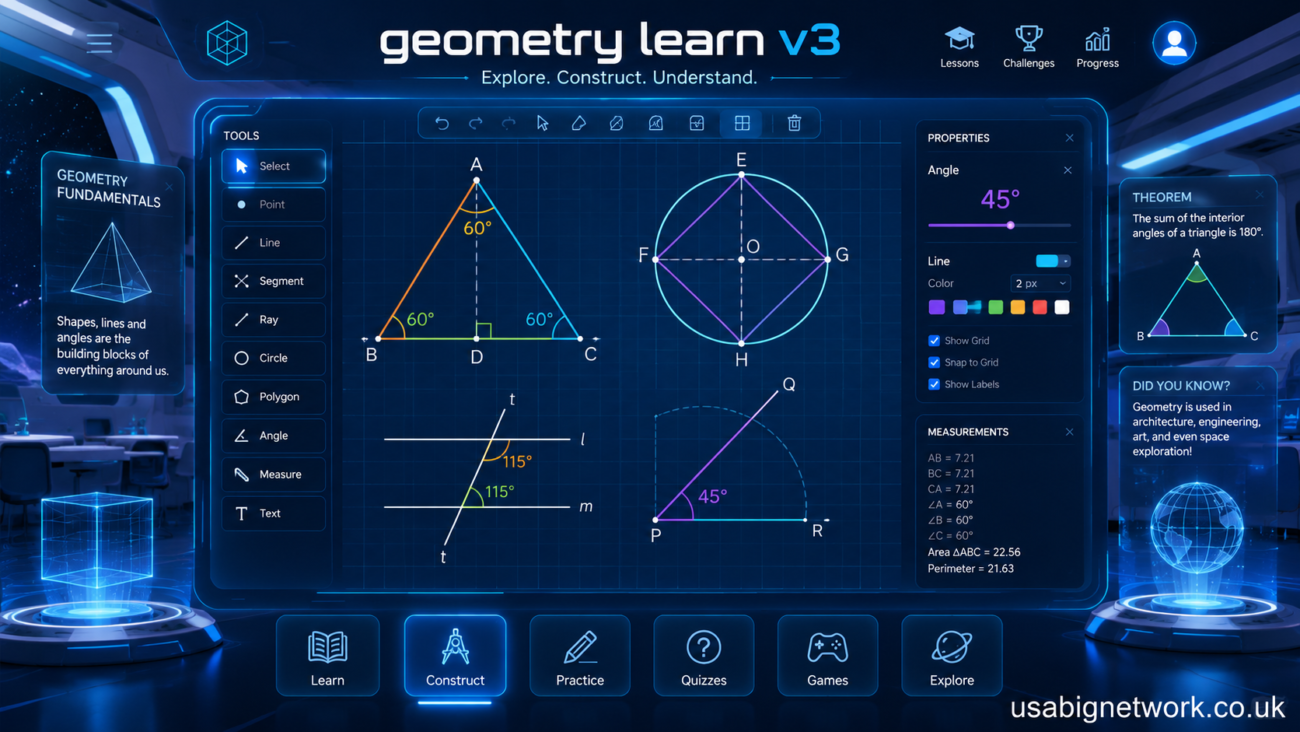
Geometry Learn V3 includes a range of features designed to support learners in understanding both foundational and advanced geometry. One of the most impactful features is its dynamic visual toolset. Students can interact with virtual compasses, protractors, grids, coordinate systems, and construction lines, all of which respond instantly to adjustments. These tools mimic the experience of hands-on geometric construction, making digital learning feel authentic and intuitive.
Another major feature is the platform’s ability to provide immediate conceptual outcomes. As learners adjust shapes or angles, Geometry Learn V3 updates all associated calculations—such as area, perimeter, or coordinate points—automatically. This instant feedback helps students recognize patterns, verify their understanding, and identify errors. It acts as a built-in educator, offering quiet guidance as learners navigate the complexities of geometric relationships.
The platform also incorporates guided tasks and challenge-based learning. These structured activities help learners apply their skills in practical contexts, ensuring that they not only manipulate shapes but also solve problems and construct proofs. By blending guidance with exploration, Geometry Learn V3 creates a balanced environment where learners grow both their confidence and competence. Every feature works together to create a fluid and supportive experience that mirrors real-world mathematical inquiry.
The Importance of Visualization in Geometry Learning
Geometry is unique among mathematical disciplines because it relies heavily on visual reasoning. Visualization is not just a supplementary skill—it is the foundation of geometric understanding. Geometry Learn V3 centers visualization at the heart of its learning model, recognizing that learners must “see” geometry to truly comprehend it. Through interactive diagrams, transformations, and animated constructions, students develop the mental spatial reasoning skills essential for both academic success and real-world problem-solving.
Visualization enhances understanding by turning abstract concepts into concrete experiences. When learners see how angles behave as a triangle’s shape changes or how reflections function across a line, they develop stronger intuition for geometric rules. Geometry Learn V3’s dynamic visual environment strengthens this intuition by making every concept observable, manipulable, and repeatable. This supports deeper learning and helps students retain knowledge more effectively.
Visualization also helps students who traditionally struggle with numerical or text-based learning formats. Many learners find written explanations of geometric rules difficult to interpret. However, when they can observe a concept visually, it becomes much easier to understand. By providing a multi-sensory pathway to learning, Geometry Learn V3 promotes inclusivity and ensures that geometry becomes accessible to a wider range of learners.
Why Geometry Learn V3 Benefits Students and Educators
Geometry Learn V3 offers significant value to students by addressing common challenges associated with geometry learning. Many students have difficulty interpreting textbook diagrams and understanding proofs that rely on symbolic notation. Through interactive tools, the platform bridges these gaps and provides clarity. Students can work at their own pace, revisit concepts as needed, and explore geometric behaviors that deepen comprehension beyond surface-level definitions.
Educators benefit as well because Geometry Learn V3 provides a flexible tool that can be integrated into classroom instruction. Teachers can use the platform to demonstrate geometric properties dynamically, making lessons more engaging and easier to understand. Instead of relying solely on sketches drawn on the board, educators can use the interactive tools to show precise constructions, transformations, and variations. This supports visual learners and enhances teaching efficiency.
Beyond the classroom, the platform supports independent learning for individuals preparing for standardized tests, entrance exams, or personal skill development. Its intuitive design allows users to navigate complex topics without requiring extensive guidance. This flexible accessibility makes Geometry Learn V3 not just a learning platform but an ongoing mathematical resource suitable for learners of all ages.
How Geometry Learn V3 Builds Confidence Through Exploration
Confidence plays a crucial role in a learner’s willingness to engage with mathematics. Geometry Learn V3 strengthens confidence by giving students the freedom to explore geometric ideas without fear of mistakes. Since the platform provides real-time feedback, learners can experiment with shapes and observe outcomes immediately. This helps reduce anxiety and fosters a mindset where exploration becomes a natural part of learning.
Through the iterative process of adjusting shapes and testing theories, learners develop stronger problem-solving skills. They learn how geometric elements relate and how transformations function intuitively. When mistakes occur, the platform guides learners toward discovery rather than penalizing them. This encourages persistence, curiosity, and resilience—qualities essential for long-term academic success.
By building confidence through exploration, Geometry Learn V3 transforms how learners perceive geometry. Instead of viewing it as a rigid subject governed by fixed rules, students begin to see it as a creative and logical system that can be mastered through practice, observation, and active engagement. This shift in mindset contributes to both improved performance and a more positive attitude toward mathematics.
The Role of Technology in Modern Geometry Education
Technology has reshaped how students learn, and Geometry Learn V3 stands as an example of how digital tools can enhance mathematical understanding. Beyond convenience, technology enables interactive capabilities that traditional methods cannot replicate. Geometry Learn V3 uses this advantage to deliver a learning experience that blends precision with flexibility, allowing learners to test ideas instantly and visualize results with accuracy.
The role of technology in geometry extends beyond interactive shapes. It helps simulate real-world applications where geometry is essential, such as engineering, architecture, animation, and design. By providing technological tools that mirror these applications, Geometry Learn V3 makes learning more relevant and practical. Students not only understand geometric principles—they also see how those principles apply beyond the classroom.
As digital education continues to evolve, platforms like Geometry Learn V3 will become increasingly vital. They support personalized learning, providing each user with the ability to study at their own pace and revisit challenging topics without pressure. This aligns with educational trends that prioritize flexibility, accessibility, and learner engagement. Technology elevates geometry from a static subject to an interactive experience, making the learning process more powerful and effective.
Conclusion: Why Geometry Learn V3 Represents the Future of Geometry Learning
Geometry Learn V3 has successfully redefined how learners interact with one of the most visually dependent subjects in mathematics. By replacing static diagrams with interactive experiences, the platform offers a modern and intuitive approach to geometry education. Its emphasis on visualization, exploration, and real-time manipulation allows learners to develop genuine understanding rather than relying on memorization. For students, educators, and independent learners alike, this platform provides a clear pathway to mastering geometric concepts with confidence.
As digital learning continues to expand, Geometry Learn V3 stands out as a forward-thinking resource that blends technology with mathematical instruction in a meaningful way. Its structure, tools, and interactive features create a comprehensive and supportive environment where geometry becomes accessible, enjoyable, and deeply understandable. Through this innovation, Geometry Learn V3 not only enhances learning outcomes but also inspires curiosity and confidence in mathematics—qualities essential for future academic and professional success.
